Jo Zindagi Mili — A Quietly Powerful Story About Life, Relationships, and the Courage to Keep Moving Forward

Jo Zindagi Mili by Ganpat Banjara is a deeply emotional and reflective work that explores the many layers of ordinary life—its struggles, sacrifices, relationships, disappointments, responsibilities, and moments of hope. Rather than depending on dramatic twists or exaggerated situations, the book draws its strength from experiences that feel familiar and human. It looks closely at the kind of emotions people often carry silently: the weight of expectations, the pain of losing something important, the responsibility of standing by loved ones, and the difficult process of accepting life as it unfolds.
One of the most appealing qualities of the book is its simplicity. The story does not try to make life appear more glamorous or more tragic than it actually is. Instead, it presents situations with a sense of honesty. This gives the narrative a natural emotional quality. The reader is not merely observing the characters from a distance; gradually, their concerns begin to feel personal. The struggles depicted in the story may belong to specific individuals, but the emotions behind those struggles are universal.
At the heart of the book is the idea that life rarely moves according to our plans. People make choices, build dreams, form relationships, and imagine certain futures for themselves, but circumstances often take them in unexpected directions. Jo Zindagi Mili reflects on what happens after those expectations are challenged. It asks an important question without stating it too loudly: when life does not give us exactly what we wanted, can we still find meaning in what remains?
That theme gives the book emotional depth. The title itself carries a sense of acceptance—“the life that was given.” It suggests not defeat, but an attempt to understand and embrace reality. There is something quietly philosophical in this idea. Life is not always about getting a perfect beginning or a perfect ending; sometimes it is about learning how to live with the circumstances we receive and still finding a reason to move forward.
The emotional journey of Raghav becomes particularly significant in this context. His experiences are shaped not only by what happens around him but also by the way he responds internally. The book gives space to his vulnerability, uncertainty, responsibilities, and personal conflicts. This makes him feel more like a real person than a conventional fictional hero. He is not presented as someone who always knows the right answer. Instead, his journey reflects confusion, emotional strain, hope, hesitation, and gradual maturity.
That realism makes his character relatable. Readers may recognise certain parts of themselves in his reactions. There are moments when people want to make the right decision but do not know what “right” actually means. There are times when duty and personal desire move in different directions. There are moments when silence becomes easier than explanation. Raghav’s journey captures many such emotional realities.
The book also pays close attention to relationships. Family, companionship, emotional attachment, responsibility, and sacrifice all play an important role in shaping the narrative. These relationships are not treated as decorative elements around the main story; they are central to it. The choices made by one person often affect several others, and the book understands this interconnectedness very well.
This is especially meaningful because real life rarely allows decisions to remain entirely individual. A person may want one thing for themselves but feel bound by family expectations, social responsibilities, or emotional commitments. Jo Zindagi Mili presents this tension with sensitivity. It recognises that sacrifice is often complicated. Sometimes sacrifice is made out of love. Sometimes out of fear. Sometimes out of responsibility. And sometimes, people sacrifice so much that they begin to question whether they have lost part of themselves along the way.
The story’s treatment of pain is also noteworthy. It does not present suffering merely for emotional effect. Instead, pain becomes a part of personal growth. Difficult experiences force the characters to reconsider what matters to them. In this sense, the book is not simply about hardship; it is about what hardship reveals.
This reflective quality gives the book a lasting emotional impact. Certain moments may remind readers of decisions from their own lives—relationships they could not save, responsibilities they accepted without complaint, opportunities they missed, people they could not understand at the right time, or dreams they quietly adjusted because circumstances demanded it.
Another strength of the book is its ability to find emotional significance in everyday situations. Many powerful stories are built not from extraordinary events but from familiar moments—a conversation left unfinished, a decision taken for someone else, a memory that refuses to fade, a period of separation, or the quiet realisation that life has changed permanently. Jo Zindagi Mili understands the emotional value of such moments.
The narrative also carries a strong sense of resilience. Importantly, resilience here does not mean that the characters stop feeling pain or suddenly become fearless. Instead, resilience appears in smaller and more believable forms: continuing despite disappointment, accepting a difficult truth, taking responsibility after a mistake, standing beside someone when circumstances become uncomfortable, or simply beginning again after a setback.
This makes the book hopeful without becoming unrealistic. Its optimism is not based on the idea that everything eventually becomes perfect. Rather, it suggests that people can still create meaning, relationships, dignity, and hope even when life remains imperfect.
The writing style supports this emotional tone. The narrative feels accessible and direct, making it easy for readers to connect with the emotions without having to work through overly complicated language. This simplicity becomes one of the book’s strengths because the subject itself depends on emotional authenticity. The story allows feelings to emerge through situations and relationships rather than constantly explaining them.
There is also an important contrast between external life and internal life throughout the story. From the outside, a person may appear ordinary, responsible, settled, or even strong. Internally, however, that same person may be carrying regret, fear, loneliness, or uncertainty. Jo Zindagi Mili captures this gap effectively. It reminds us that every person we meet may be dealing with a story that is not visible to others.
This idea adds empathy to the book. It encourages readers not to judge people too quickly based only on their choices or behaviour. Behind every action may exist circumstances, fears, responsibilities, or emotional wounds that others do not fully understand.
The book’s emotional world is strengthened further by its focus on memory. Our past often continues to influence us long after an event has ended. A conversation, a person, a mistake, or a moment of happiness can remain alive in memory and shape future choices. Jo Zindagi Mili explores this connection between past and present in a way that feels natural.
At the same time, the story does not remain trapped entirely in regret. It moves towards understanding and acceptance. The characters gradually recognise that while the past cannot always be changed, its meaning can change. A painful experience can later become a lesson. A mistake can become a point of self-awareness. A loss can deepen one’s understanding of relationships. This transformation is subtle but meaningful.
For readers who enjoy stories centred on human emotions rather than constant action, this book has much to offer. It will particularly appeal to those who appreciate narratives about family, personal responsibility, emotional growth, relationships, sacrifice, and second chances.
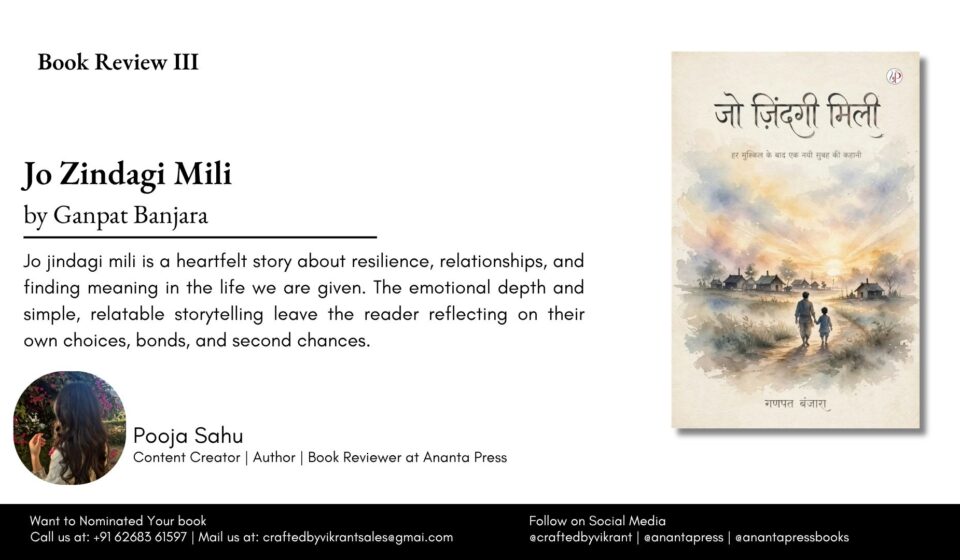
The rural and grounded visual atmosphere associated with the book also complements its themes beautifully. The image of a road, a rising sun, and figures moving forward together symbolically reflects the central spirit of the story. Life continues. Roads change. People walk beside us for different distances. Some journeys are chosen, while others are simply given to us. What finally matters is how we travel through them.
The book’s message becomes increasingly meaningful as the story progresses: fulfillment does not always come from receiving the exact life we once imagined. Sometimes it comes from learning to recognise the value of the life already in front of us.
That does not mean accepting injustice or giving up on dreams. Rather, it means understanding the difference between what can be changed and what must be accepted. It means finding strength in reality instead of endlessly fighting with what has already happened.
This mature emotional perspective is what separates Jo Zindagi Mili from a purely sentimental story. It is not simply asking readers to feel sorry for its characters. It asks them to understand them.
The novel also serves as a reminder that ordinary people often show extraordinary courage without recognising it as courage. A parent who silently sacrifices, a person who keeps a family together during a difficult period, someone who forgives after being hurt, or an individual who starts life again after disappointment may never be celebrated publicly. Yet these everyday acts of endurance can be deeply meaningful.
In this way, the book honours lives that are usually overlooked.
Ultimately, Jo Zindagi Mili is a thoughtful and emotionally resonant exploration of what it means to live with both hope and limitation. It acknowledges that life can be unfair, confusing, and unpredictable, but it does not stop there. It also shows that love, responsibility, understanding, forgiveness, and resilience can help people move forward.
The story leaves the reader with a quiet sense of reflection. It may encourage them to think about their own journey—not only the things they wish had happened differently, but also the people, experiences, and opportunities that have shaped the life they have today.
That is perhaps the book’s most meaningful achievement. It does not offer a perfect formula for happiness. Instead, it gently reminds us that even an imperfect life can carry beauty, purpose, relationships, lessons, and new beginnings.
Jo Zindagi Mili is therefore more than a story about one person’s struggles. It is a reflection on human life itself—the compromises we make, the relationships we protect, the pain we carry, the mistakes we learn from, and the hope that continues to lead us toward another morning.