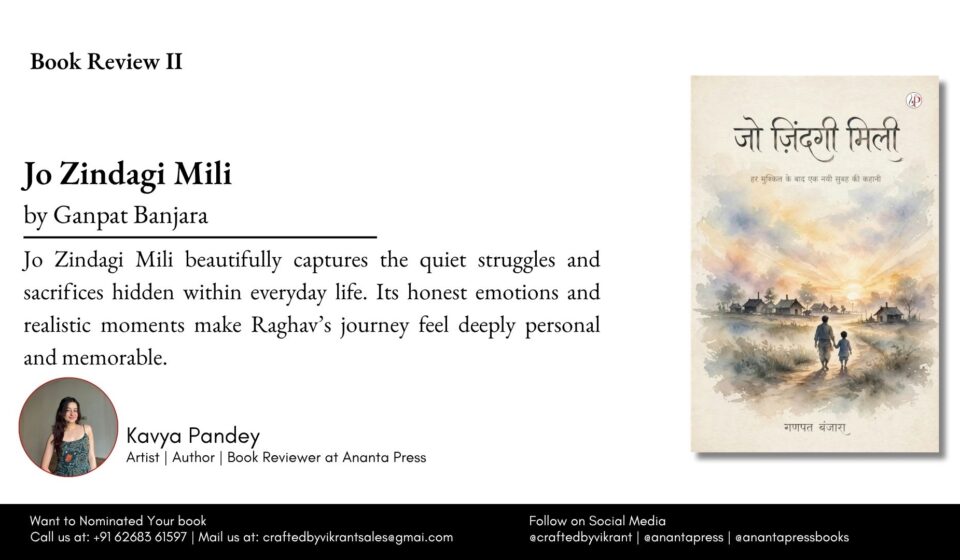

Jo Zindagi Mili by Ganpat Banjara is a deeply human story that finds meaning not in extraordinary achievements or dramatic heroism, but in the quiet struggles of an ordinary life. At its heart, the novel follows Raghav, a man whose journey reflects the experiences of countless people who grow up in modest families, learn to carry responsibilities, face financial pressures, build relationships, suffer disappointments, and still continue moving forward with hope. The book’s greatest strength lies in its simplicity. It does not try to make life appear grander than it is; instead, it shows how even the smallest moments can hold enormous emotional value.
Raghav is introduced not as someone destined for greatness, but as a child born into a simple household where love is present even when money is limited. His parents, Mohanlal and Saroj, become important emotional pillars of the story. Through them, the author explores the quiet sacrifices that parents make without expecting recognition. Mohanlal’s character, in particular, represents the kind of father whose responsibilities are often greater than what his words reveal. His worries remain hidden behind everyday routines, small purchases, household calculations, and his desire to give his son a better life.
One of the most touching aspects of the book is the way it portrays childhood. Raghav’s early world is small: his mother’s lap, his father’s hand, the family home, a sweet brought from the market, a toy, or a bicycle seen in the neighbourhood. These details create a feeling of familiarity and nostalgia. The author shows that childhood memories are rarely built around major events. Instead, they are made from seemingly ordinary experiences that later become precious.
The relationship between Raghav and his mother is especially warm. Saroj’s presence communicates care through action rather than elaborate dialogue. She wakes during the night when her child cries, watches him take his first steps, protects him, worries when he wanders outside, and quietly adjusts herself around the changing needs of the family. These scenes feel believable because they are rooted in daily life rather than exaggerated sentiment.
Similarly, the chapter focusing on the father’s pocket becomes a beautiful metaphor for parenthood. To a child, a father’s pocket may contain coins, a handkerchief, a ticket, or perhaps a toffee. To the father, however, that same pocket contains the pressure of household expenses, pending bills, responsibilities, and compromises. The contrast is simple but emotionally powerful. Raghav looks for sweets while Mohanlal carries the calculations of an entire household. The book reminds readers that children often understand their parents’ sacrifices only much later in life.
As Raghav grows older, the novel gradually moves from innocence toward responsibility. Education, employment, money, marriage, family obligations, and future planning begin to shape his life. This transition is presented naturally. The author does not create a sudden transformation in the protagonist; instead, Raghav slowly learns that adulthood is less about personal freedom and more about learning to balance one responsibility after another.
After completing his studies, Raghav begins working and tries to establish himself while managing the needs of his family. A limited salary makes every decision important. The novel captures a reality that many middle-class and lower-middle-class families understand very well: income may arrive regularly, yet expenses seem to arrive even faster. Rent, household necessities, family needs, debt, medical expenses, and future responsibilities become part of everyday life.
Marriage brings another important shift. Parvati becomes Raghav’s life partner, and their relationship adds a new emotional dimension to the story. Marriage in this book is not presented only as romance or celebration. It becomes a partnership tested by practical circumstances. As expenses and responsibilities increase, husband and wife must learn to face difficulties together. This realistic approach gives the story maturity.
One of the more serious turning points comes when Raghav’s father falls ill. The family is suddenly confronted with hospital visits, treatment, financial anxiety, and emotional fear. Such circumstances test not only a person’s economic strength but also relationships within a family. During this phase, Raghav begins to understand that money, though important, is not the only form of wealth. The presence of loved ones, emotional support, patience, and the willingness to stand together during difficult moments become equally valuable.
The arrival of Raghav’s own child adds another layer to his development. Once he becomes a father, his responsibilities increase, but so does his desire to create a better future. In many ways, this stage brings his life full circle. The reader can remember Mohanlal looking at infant Raghav and hoping that his son would have a better life. Now Raghav begins experiencing similar concerns for his own family.
The book becomes particularly relatable when Raghav tries to improve his financial condition beyond his regular job. He begins taking up accounting work on a small scale, hoping to create something of his own. His efforts are not immediately rewarded with effortless success. He experiences mistakes, losses, uncertainty, and moments when he questions whether his hard work is producing any result at all. Yet he continues.
This is where Jo Zindagi Mili becomes more than a family story. It becomes a story about perseverance. The book does not suggest that persistence guarantees instant success. Instead, it suggests that continuing despite uncertainty is itself a form of courage.
Eventually, Raghav reaches a stage where he must decide whether to remain permanently dependent on his job or take the risk of fully committing himself to the work he has built through experience, savings, and effort. This choice becomes one of the defining decisions of his life. It reflects a fear experienced by many people: choosing between security and possibility.
Ganpat Banjara’s writing style is intentionally straightforward. He avoids excessively complex literary language and focuses on emotional clarity. This makes the book accessible to readers who may not regularly read literary fiction. The language feels conversational, and the short scenes help create an easy reading rhythm.
There is also a quiet cinematic quality in several moments. A father counting coins at night, a child waiting near the door for his father to return, a mother watching her son take his first steps, a family worrying outside a hospital room, or a man sitting with the uncertainty of a major career decision—these images stay with the reader because they feel real.
Another important quality of the novel is its respect for ordinary people. Raghav is not extraordinary because he defeats impossible odds in a dramatic way. He becomes meaningful because he keeps showing up for life. He goes to work, worries about money, cares for his parents, builds a marriage, becomes a father, makes mistakes, suffers setbacks, and tries again.
This is also where the title Jo Zindagi Mili gains significance. Life rarely unfolds exactly according to our plans. People imagine certain careers, financial stability, relationships, success, and happiness, but reality introduces delays, responsibilities, illness, debt, mistakes, and unexpected changes. The central message of the book is not that we should passively accept everything. Rather, it suggests that we must understand the life we have received, accept its realities, and still make an effort to improve it.
The emotional appeal of the novel comes largely from recognition. Readers may see their own father in Mohanlal, their mother in Saroj, their partner in Parvati, or themselves in Raghav. Someone may remember waiting for a parent to return from work. Another reader may recognise the anxiety of counting expenses at the end of the month. Someone else may relate to supporting an ill parent, paying debts, raising a child, or attempting to build a second source of income.
The novel’s realism is strengthened by its understanding that struggle does not always look dramatic from the outside. Sometimes struggle looks like going to work every morning while carrying anxiety silently. Sometimes sacrifice looks like delaying a personal purchase so a child can have something small. Sometimes courage means beginning again after a financial loss. Sometimes hope is simply the decision to get up the next day and continue.
This philosophy is expressed throughout Raghav’s journey. The book acknowledges that people fail, worry, become tired, and occasionally feel that everything has stopped. Yet life continues, and people often discover new strength precisely because they have responsibilities that do not allow them to give up.
For readers who enjoy fast thrillers, elaborate twists, or larger-than-life protagonists, Jo Zindagi Mili may feel deliberately quiet. But that quietness is part of its identity. The book is not trying to impress through spectacle. It wants the reader to observe, remember, and feel.
Ganpat Banjara’s debut therefore succeeds most strongly as an emotional portrait of everyday Indian family life. His focus remains on relationships, responsibilities, parental sacrifice, financial realities, hope, and the determination to create something better despite limited circumstances.
By the end, Raghav’s journey feels less like the story of one fictional man and more like a reflection of millions of people who carry dreams larger than their resources. They may experience financial difficulties, setbacks, uncertainty, and disappointment, but they continue because family, responsibility, and hope give them reasons to move forward.
Jo Zindagi Mili ultimately leaves behind a simple but meaningful thought: a valuable life does not have to be perfect. It has to be lived with sincerity, responsibility, love, resilience, and the courage to keep trying.
For anyone who enjoys realistic stories about family, personal growth, parental sacrifice, financial struggle, and ordinary people finding strength in difficult circumstances, this book offers a warm and emotionally familiar reading experience. It reminds us that even an ordinary life contains countless untold stories—and sometimes those are the stories that stay with us the longest.