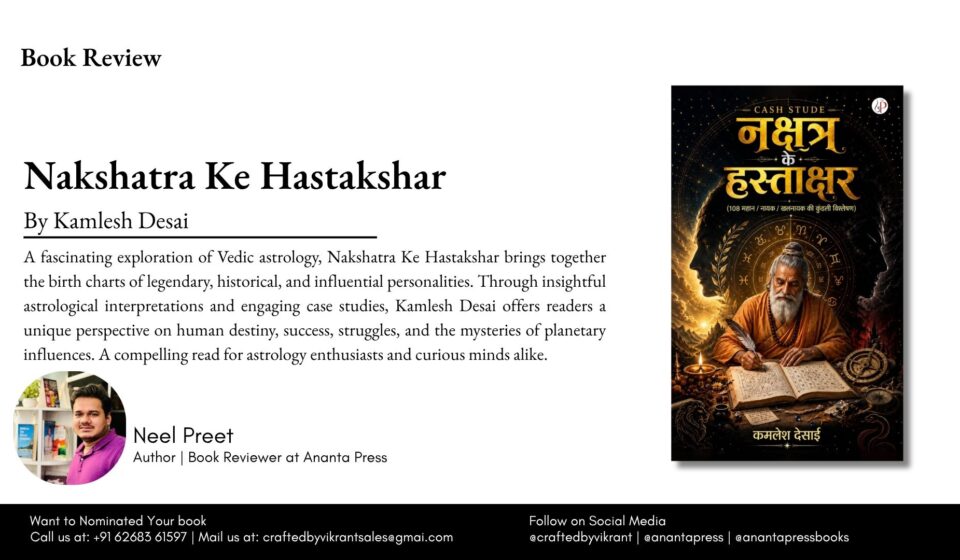
Nakshatra Ke Hastakshar – Exploring the Cosmic Connections Between Destiny, History, and Human Life

Book Title: Nakshatra Ke Hastakshar (नक्षत्र के हस्ताक्षर)
Author: Kamlesh Desai
Genre: Vedic Astrology, Spirituality, and Biographical Studies
A Fascinating Journey Through Astrology and Human Destiny
What makes one individual rise to extraordinary greatness while another experiences unexpected setbacks? Why do some personalities leave an everlasting mark on history, while others become remembered for their controversial decisions and actions? These questions have fascinated human beings for centuries, inspiring philosophical discussions, spiritual investigations, and astrological interpretations.
In Nakshatra Ke Hastakshar, author Kamlesh Desai approaches these questions through the traditional framework of Vedic astrology, exploring the relationship between planetary positions, individual characteristics, personal struggles, and significant life events.
The book offers a distinctive collection of astrological case studies involving mythological figures, historical personalities, influential leaders, spiritual thinkers, and contemporary public figures. Rather than focusing exclusively on predicting the future, Desai encourages readers to examine established life stories through the symbolic language of birth charts.
What makes the book particularly interesting is its effort to connect astrology with familiar personalities and historical narratives. Readers encounter figures whose lives are already associated with courage, ambition, wisdom, sacrifice, leadership, controversy, or remarkable achievement. Their stories become the foundation for exploring traditional astrological concepts and interpreting planetary combinations.
For anyone interested in understanding how Vedic astrology approaches human personality and destiny, this book provides an engaging starting point.
A Distinctive Approach to Understanding Vedic Astrology
One of the book’s most appealing qualities is its case-study-oriented structure.
Astrology can sometimes appear complicated to beginners because of its extensive terminology, planetary relationships, zodiac signs, houses, conjunctions, and interpretive principles. Learning these ideas only through theoretical explanations can feel overwhelming.
Desai attempts to make these concepts more approachable by relating them to recognizable human experiences.
The book introduces readers to the traditional interpretation of planetary placements and their supposed connections with leadership, emotional strength, intellectual abilities, ambition, prosperity, and adversity.
Through its analysis of birth charts, the author demonstrates how astrologers interpret combinations involving the Sun, Moon, Mars, Mercury, Jupiter, Venus, Saturn, Rahu, and Ketu.
Importantly, these explanations are presented within the interpretive traditions of Vedic astrology. They should be understood as astrological perspectives rather than scientifically established explanations of human behaviour or historical outcomes.
This distinction does not diminish the book’s cultural or educational interest. Instead, it helps readers appreciate the work for what it seeks to accomplish: an exploration of a longstanding Indian system of interpretation through concrete examples.
Bringing Mythology and History Together
Another noteworthy feature of Nakshatra Ke Hastakshar is the breadth of personalities included in its planned collection.
The book draws from Indian mythology, ancient civilizations, medieval history, modern political movements, scientific achievements, cultural developments, and contemporary public life.
The inclusion of figures from the Ramayana and Mahabharata creates an interesting connection between traditional astrological thinking and India’s literary and spiritual heritage.
Personalities such as Lord Rama, Sita, Ravana, Lord Krishna, Arjuna, Karna, and other mythological characters provide material for discussing virtues, moral dilemmas, power, and the consequences of individual choices.
Readers familiar with these narratives may find it particularly engaging to encounter familiar characters through a different interpretive lens.
The historical range is equally ambitious.
The book’s wider list includes influential figures such as Chanakya, Emperor Ashoka, Julius Caesar, Chhatrapati Shivaji Maharaj, Napoleon Bonaparte, Mahatma Gandhi, Swami Vivekananda, Albert Einstein, and several others.
The attraction of this approach lies in the diversity of human experiences it brings together.
A spiritual teacher and a military leader may possess entirely different ambitions. A scientist may be remembered for intellectual discovery, while a social reformer may be celebrated for compassion and service. Yet the book examines such different lives through a common astrological framework.
This comparative approach encourages readers to observe how traditional astrologers interpret contrasting patterns of achievement, responsibility, conflict, and personal development.
Exploring Success, Failure, and Human Complexity
A particularly engaging aspect of the book is its willingness to examine both admired personalities and controversial historical figures.
Many books about astrology focus primarily on favourable planetary combinations associated with wealth, fame, authority, and professional success.
Desai takes a broader approach by incorporating individuals whose lives involved major conflicts, controversial decisions, or dramatic reversals.
This creates opportunities for comparing the traditional astrological interpretations associated with success and struggle.
The central theme is not merely that individuals possess different destinies. It is also that human experience contains extraordinary contradictions.
Someone may demonstrate remarkable courage while making questionable decisions. Another individual may overcome enormous obstacles through discipline and persistence. A person born into difficult circumstances may eventually become an influential leader.
By examining such contrasting experiences, the book invites readers to consider the complex relationship between personal choices, circumstances, reputation, and the traditional idea of planetary influence.
The treatment of these subjects makes the work more than a simple catalogue of astrological terminology.
It becomes a collection of life stories interpreted through a cultural and philosophical system that has influenced Indian thought for generations.
An Emphasis on Learning Through Practical Examples
One of the strongest elements of the book is its educational intention.
In the introductory sections, Desai explicitly states that the work is intended to help students, researchers, and curious readers develop their understanding of astrology through observation and analysis.
The book includes guidance on how readers should approach a birth chart.
It encourages attention to the ascendant, planetary placements, the Moon and Sun, the twelve astrological houses, planetary relationships, combinations known as yogas, and traditional timing concepts such as dashas and transits.
This guidance is especially useful for beginners who may otherwise find it difficult to know where to begin.
Rather than encouraging readers to focus on one planetary placement in isolation, the author emphasizes the importance of considering the chart as a whole.
That principle gives the book a more systematic character within its chosen astrological framework.
The explanations also encourage readers to move beyond memorization.
Readers are invited to compare examples, recognize recurring interpretive patterns, and develop their ability to examine a chart from multiple perspectives.
This approach makes the book potentially valuable as supplementary reading for students who are already studying traditional astrology.
The Inspirational Dimension of the Book
Beyond technical discussion, Nakshatra Ke Hastakshar contains a meaningful inspirational element.
The author’s treatment of social reformer Padma Shri Kanta Bahen Tyagi is especially notable.
Her life, marked by sacrifice, dedication to education, and service to communities in remote regions, receives considerable attention.
The discussion does not simply summarize her achievements. It interprets her commitment to public service through a traditional astrological framework, connecting her life story with themes of discipline, compassion, courage, and social responsibility.
Whether or not readers accept the astrological interpretations, the underlying biographical narrative highlights the importance of meaningful human action.
This feature adds emotional depth to a subject that might otherwise remain highly technical.
The emphasis on service, responsibility, and perseverance also reminds readers that the true significance of an individual life cannot be measured only through fame or material success.
The book’s introductory message acknowledges the importance of education, personal effort, ethical conduct, and thoughtful decision-making.
That emphasis gives the work a reflective dimension and prevents its subject matter from being limited solely to predictions or abstract planetary symbolism.
The Author’s Knowledge and Educational Perspective
Kamlesh Desai brings the perspective of an experienced educator to this project.
His background in teaching, combined with his interest in astrology, birth-chart interpretation, and palmistry, helps explain the book’s instructional ambitions.
The work reflects an effort to organize traditional astrological concepts into a format that encourages readers to observe, compare, and learn.
Rather than presenting the material entirely as abstract theory, Desai uses examples to connect astrological terminology with narratives that readers may recognize.
The tone is often enthusiastic and deeply respectful of Indian intellectual and cultural traditions.
The author’s admiration for astrology is evident throughout the introductory material, as is his desire to introduce younger generations to the subject.
This commitment gives the book a personal quality.
It reads not simply as a collection of information but also as an expression of the author’s long-standing interests and his wish to share what he has studied.
A Valuable Cultural Perspective, With Room for Critical Reflection
The book’s greatest strength is also the source of an important consideration for readers.
Its interpretations emerge from the traditions and assumptions of Vedic astrology. While the book sometimes presents astrology in scientific language, the claim that planetary positions determine personality, success, or historical events is not established by modern scientific evidence.
Readers approaching the book from an academic or scientific perspective should therefore distinguish between traditional astrological interpretation, independently verifiable historical information, and the author’s conclusions.
Another consideration is the nature of the birth-chart information used in historical and mythological case studies.
For many ancient personalities, reliable birth details may be unavailable or impossible to verify. As the author acknowledges in his introduction, the collection draws on materials gathered from different sources, including astrological communities and online references.
Consequently, readers should treat uncertain charts as illustrative or interpretive examples rather than verified historical records.
These limitations are important, but they do not prevent the book from being appreciated as an exploration of a traditional knowledge system.
Indeed, readers who approach the material with curiosity and thoughtful skepticism may find the discussions particularly stimulating.
The work encourages questions about history, personality, belief, interpretation, and the ways different cultures attempt to understand human experience.
Why This Book Stands Out
Many introductory books on Vedic astrology concentrate on definitions, calculations, and established rules.
Nakshatra Ke Hastakshar distinguishes itself by placing personalities and their life experiences at the centre of the discussion.
This makes the material more accessible to readers who enjoy biographies, historical narratives, and comparative studies.
Its combination of mythological references, historical personalities, contemporary examples, and practical explanations gives it considerable thematic range.
The instructional sections provide a framework for approaching individual charts, while the biographical material adds interest and variety.
The book is particularly suitable for readers who appreciate traditional Indian thought and want to understand how astrological interpretations are applied to life stories.
It may also encourage further reading about the historical personalities discussed, the development of Indian astrology, and the relationship between inherited cultural beliefs and modern scholarship.
Final Verdict
Nakshatra Ke Hastakshar is an ambitious and engaging exploration of human life through the interpretive traditions of Vedic astrology.
Kamlesh Desai combines biographical narratives, mythological references, historical examples, and astrological principles to create a work designed to encourage curiosity and analytical study.
Its most distinctive achievement is the way it brings complex astrological ideas into conversation with recognizable personalities and memorable life experiences.
Although its astrological conclusions should be approached as traditional interpretations rather than scientifically verified facts, the book offers a rich introduction to the ideas, symbolism, and cultural perspectives associated with Vedic astrology.
For beginners, astrology enthusiasts, and readers interested in India’s intellectual and spiritual traditions, it presents an interesting opportunity to explore how people have sought meaning in the relationship between the heavens and human existence.
Overall, Nakshatra Ke Hastakshar is a thought-provoking work that invites readers to look beyond individual life events, examine traditional astrological symbolism, and reflect on the enduring human fascination with destiny, achievement, and the mysteries of existence.