Inner Awakenings Through Mahabharat: Finding Ourselves in the Stories We Thought We Knew

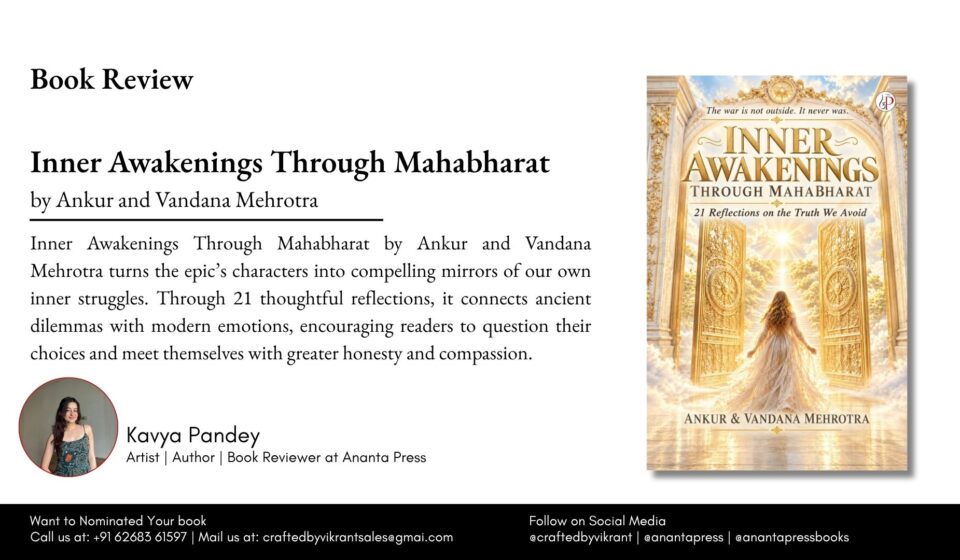
Some books invite us into another world; others make us look more closely at the world within us. Inner Awakenings Through Mahabharat: 21 Reflections on the Truth We Avoid by Ankur and Vandana Mehrotra belongs to the second kind. Drawing on the emotional and moral complexity of the Mahabharat, it asks readers to examine the fears, attachments, justifications, and unspoken desires beneath their everyday decisions. Its appeal lies in the way it brings a vast epic into intimate conversation with ordinary life. Kings, warriors, teachers, and mothers become recognisable human figures whose conflicts feel surprisingly close to our own.
The book’s central idea is that outward conflict often begins with an inward struggle. Before a decision becomes an action, there may already be a battle between conscience and convenience, love and possessiveness, or responsibility and fear. The authors explore this space through twenty-one character-focused reflections. Their approach encourages readers to consider how people explain themselves publicly and what they may privately understand about their motives. This creates a compelling foundation for a book about self-awareness: the most difficult truths are often those that threaten the identity we have carefully built.
A Clear and Thoughtful Interpretive Approach
One of the book’s strengths is its clarity about its own purpose. The authors explain that this is a personal, reflective interpretation of the Mahabharat. The imagined inner conversations, alternative choices, and contemporary stories are presented as creative devices for exploring human behaviour. That distinction matters because it helps readers understand how to approach the material. The book offers a particular lens through which to consider familiar characters, while acknowledging the epic’s many traditions and retellings. This openness gives its emotional interpretations room to work without asking readers to mistake imagination for textual authority.
The choice of the Mahabharat is especially effective because its characters resist easy moral classification. Their virtues and weaknesses frequently exist together. Loyalty can become dependence; courage can coexist with insecurity; devotion can conceal avoidance. The authors build their reflections around these tensions. Readers are invited to look beyond a character’s reputation and examine the emotional cost of maintaining it. This is where the book becomes most interesting. It suggests that even an admirable quality deserves examination when it repeatedly produces suffering, silences conscience, or prevents someone from acknowledging the consequences of a choice.
When Goodness Becomes a Defence
The opening reflection on Yudhishthira offers a strong example of this method. His association with righteousness becomes the starting point for questions about duty, fear, and self-deception. Through the dice episode, the authors consider how a person might use an accepted moral explanation to avoid admitting a more uncomfortable motive. The chapter’s value lies in the tension it creates between being regarded as good and acting with genuine awareness. It asks whether preserving the image of righteousness can sometimes interfere with recognising harm. This is a challenging question, and an appropriate opening for the book’s larger inquiry.
The accompanying modern parallel gives that inquiry practical relevance. A man repeatedly supports his brother financially, describing his decision as family responsibility, while privately struggling with his inability to refuse. The situation is ordinary enough to feel credible and complicated enough to resist a quick judgment. Generosity, fear of rejection, loyalty, and the need for belonging can overlap. By placing such experiences beside epic dilemmas, the authors make reflection accessible. Readers do not need a kingdom to lose in order to understand how difficult it can be to stop repeating a damaging decision.
A Structure That Encourages Participation
The organisation of the chapters supports the book’s reflective purpose. Each begins with an imagined scene shaped around a trigger, turmoil, and a turning point. Character background follows, along with inner responses and speculative alternatives. The contrast between public statements and private awareness then sharpens the central conflict. Contemporary parallels, observations about the unsaid, poems, and space for personal reflection extend the experience. This repeated structure provides a dependable rhythm. Readers know where they are being taken, while each character introduces a different emotional problem to consider.
The sections imagining another possible ending are particularly engaging. They encourage readers to pause at the moment when a familiar action might have taken a different direction. Their usefulness lies in directing attention towards choice. A person’s history, role, and emotional wounds may explain the pressure surrounding a decision, yet a moment of recognition can still matter. These alternatives also create a natural bridge to the reader’s life. They prompt questions about the conversation we avoided, the boundary we failed to set, or the admission that might have interrupted an established pattern.
The paired public and private voices are among the book’s most effective devices. Their arrangement makes self-justification visible. A respectable explanation stands beside an uncomfortable acknowledgement, allowing the distance between them to carry the meaning. This is a simple technique, but it suits the subject well. Many readers will recognise how easily language can make an action sound more principled than it felt. The device encourages closer attention to the stories people tell themselves, especially when those stories become so familiar that they are no longer questioned.
Ancient Conflicts, Contemporary Emotions
The range of characters gives the collection breadth. Alongside prominent figures such as Arjuna, Draupadi, Karna, Krishna, and Bhishma, the book includes Nakula and Sahadeva, Vidura, Sanjaya, Ekalavya, Shikhandi, Ghatotkacha, and others. This wider selection expands the emotional territory available for reflection. Questions of recognition, exclusion, obligation, grief, identity, and silence emerge from different positions within the epic. The result is a collection that allows readers to encounter themselves through more than one perspective. A particular chapter may resonate because of a current difficulty, while another may become meaningful later.
The contemporary examples are important to that accessibility. They bring the discussion into family relationships, work, social expectations, and familiar habits of emotional avoidance. The authors understand that people rarely describe themselves as choosing fear or seeking approval. They use the language of kindness, strength, sacrifice, or necessity. Examining that language gives the book relevance beyond readers already interested in mythology. Its questions apply wherever people struggle to distinguish a freely chosen responsibility from an obligation maintained through guilt, anxiety, or the fear of disappointing others.
The book also makes an important distinction between understanding behaviour and excusing harm. Its introductory guidance explicitly recognises that emotional explanation does not remove accountability. This strengthens the reflective approach. Compassion becomes more useful when it permits an honest view of consequences. Readers can acknowledge a character’s suffering while still questioning the actions that follow from it. Applied personally, the same principle encourages a more mature form of self-examination: one can recognise the origins of a harmful pattern and accept responsibility for changing it without reducing oneself to that pattern.
Language, Atmosphere, and Reading Experience
The prose generally favours directness and emotional immediacy. Short statements, questions, and familiar vocabulary make the reflections approachable. Explanations of characters and terms help readers who have limited knowledge of the epic. At the same time, the opening scenes introduce a more dramatic, symbolic register through images of fire, mirrors, silence, and fractured identities. These passages give emotional conflict a visible shape. The movement between imaginative scenes and plainspoken reflection helps the book accommodate readers who respond differently to storytelling, explanation, or personal questioning.
The poems and closing passages soften the transition from analysis to contemplation. They give readers a chance to stay with an emotion before moving towards an explanation. The blank spaces for personal realisations reinforce this participatory quality. This is a book designed to be paused over. Its suggestion to read one chapter and allow its questions to settle feels appropriate to the material. A quick reading may reveal the overall themes, but a slower pace gives the repeated invitations to self-examination more opportunity to become specific and useful.
That repetition also creates the book’s main limitation. Readers who prefer continuous narrative or substantial variation in chapter design may find the recurring pattern predictable. The contrast between outward explanation and inward truth can sometimes make motives appear more clearly separated than they are in lived experience. People may act from care and fear simultaneously, without fully understanding either. The reflections are therefore most rewarding when treated as openings for further thought. Their strength is in generating questions that readers can test against their own circumstances.
A Meaningful Invitation to Look Within
What distinguishes Inner Awakenings Through Mahabharat is the consistency of its inward focus. Its originality lies in bringing imagined character psychology, contemporary parallels, poetry, and guided reflection into one accessible reading experience. The authors approach self-awareness with seriousness while leaving room for gentleness. They ask readers to notice uncomfortable patterns without turning every discovery into an accusation. That balance is valuable, because honest reflection becomes difficult when shame overwhelms curiosity. The book works best when its questions encourage patient attention to the motives behind repeated choices.
Ultimately, Ankur and Vandana Mehrotra offer a thoughtful companion for readers interested in the Mahabharat, reflective spirituality, and personal growth. The book makes familiar stories feel newly relevant by connecting their moral tensions with everyday emotional life. Its lasting value rests in the pause it encourages between justification and recognition. Readers may leave a chapter thinking less about what a character should have done and more about a choice awaiting them in their own lives. For a book concerned with inner awakening, that movement towards personal honesty is a meaningful achievement.