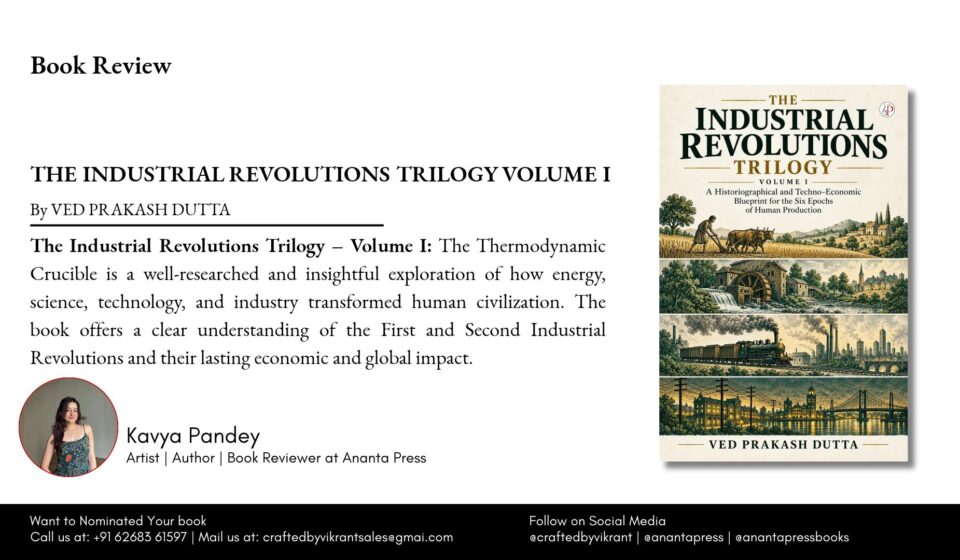
The Industrial Revolutions Trilogy – Volume I: The Thermodynamic Crucible by VED PRAKASH DUTTA

Ved Prakash Dutta’s The Industrial Revolutions Trilogy – Volume I: The Thermodynamic Crucible is an ambitious and deeply researched examination of one of the most important transformations in human history—the transition from an organic, land-dependent economy to a fossil-fuel-driven industrial civilization. Focusing on the First and Second Industrial Revolutions, the book does much more than present a chronological account of inventions. It attempts to explain the deeper relationship between energy, knowledge, technology, economics, institutions, production, and global power.
One of the book’s strongest features is its central idea that industrialization should be understood not merely as a collection of machines and inventions, but as a fundamental transformation in the physical and intellectual foundations of production. The book begins by explaining the limitations of the pre-industrial “organic economy,” where human societies depended heavily on current solar energy captured through photosynthesis. Food, animal fodder, timber, fuel, and industrial raw materials all competed for the same limited resource—land. As population increased, these competing demands created a structural constraint on economic growth. The book connects this condition with the Malthusian trap, showing why technological improvements in the pre-industrial world often resulted in temporary increases in output rather than sustained improvements in living standards.
This foundation makes the book’s explanation of the First Industrial Revolution particularly compelling. The author presents the discovery and exploitation of coal as a decisive turning point. Coal represented accumulated energy stored beneath the Earth over geological time, allowing societies to access an energy source that was no longer directly dependent on annual agricultural production. The development of steam power then converted this stored thermal energy into mechanical work. In this sense, the Industrial Revolution was not simply a technological breakthrough; it was an energy revolution that changed the limits within which human production could operate.
The discussion of steam technology is one of the most interesting sections of the book. The development from early steam engines to the improvements associated with Thomas Newcomen and James Watt demonstrates how practical engineering problems gradually encouraged increasingly sophisticated solutions. Watt’s separate condenser, for example, is presented not merely as an isolated invention but as an important step in improving the efficiency and usefulness of steam power. The book successfully demonstrates how individual technological improvements became part of a larger interconnected industrial system involving coal mining, metallurgy, transportation, textiles, and factory production.
Another major strength is the attention given to the intellectual foundations of industrialization. The author draws on Joel Mokyr’s distinction between propositional and prescriptive knowledge to explain why the Industrial Enlightenment was so important. Practical craftsmen had accumulated considerable technical knowledge, but much of it remained based on experience and experimentation rather than a systematic understanding of scientific principles. The emergence of stronger connections between scientific knowledge and practical engineering changed this situation.
The book explains how scientific societies, technical publications, educational networks, public lectures, and institutions helped reduce the barriers to useful knowledge. The relationship between scientists and practical inventors gradually became more productive. Examples involving figures such as John Smeaton, James Watt, Joseph Black, and others illustrate how scientific understanding could directly contribute to technological improvement. This creates one of the book’s central arguments: modern technological progress became increasingly self-reinforcing when scientific knowledge and practical engineering began to interact continuously.
The transition to the Second Industrial Revolution forms another important part of the volume. Here, the book describes a shift from primarily empirical mechanical innovation toward science-driven industrial development. Industrial Revolution 2.0 is associated with mass steel production, electrical power, synthetic chemistry, internal combustion engines, and increasingly sophisticated corporate organizations. Unlike many conventional histories that treat these inventions separately, the book emphasizes their interconnected nature and the institutional structures that allowed them to be commercialized on a large scale.
The discussion of electricity is particularly effective. The development of electrical systems is presented as more than the invention of individual devices. Thomas Edison’s work, for example, is considered in the context of an integrated system involving generation, distribution, wiring, meters, and lighting. Nikola Tesla’s alternating-current technology and the development of long-distance electrical transmission further demonstrate how technological systems could transform the scale and geography of industrial production. The emphasis on system integration gives the reader a better understanding of why Industrial Revolution 2.0 was fundamentally different from earlier periods of mechanical experimentation.
The book also gives significant attention to synthetic chemistry. The transformation of coal-tar waste into commercially valuable chemicals and dyes demonstrates how industrial production increasingly moved beyond dependence on naturally occurring biological resources. The development of synthetic dyes, pharmaceuticals, chemical processes, and eventually synthetic fertilizers illustrates the growing ability of science and industry to reproduce or replace materials that had previously depended on agricultural production. The book therefore presents chemistry as an important part of the larger industrial transformation rather than as a separate scientific story.
Another notable aspect is the discussion of invention itself. During the First Industrial Revolution, innovation was often associated with individual mechanics, inventors, artisans, and engineers. By the Second Industrial Revolution, invention increasingly became institutionalized within corporate research laboratories. Figures such as Thomas Edison, Nikola Tesla, Adolf von Baeyer, Fritz Haber, and Carl Bosch are discussed within this broader transformation. The book shows how patents, technical education, investment capital, managerial organizations, and corporate research created a new environment in which invention could become a systematic and continuous activity.
The emergence of the modern corporation is therefore another important theme. Large-scale industrial technologies required significant capital, specialized knowledge, coordinated production, and complex distribution systems. The book explains how the rise of multi-unit managerial corporations, particularly in the United States and Germany, provided the organizational structure needed to commercialize new technologies. Corporate research laboratories became important engines of innovation, creating a closer relationship between scientific research, industrial production, and commercial strategy.
Importantly, The Thermodynamic Crucible does not present industrialization as an entirely positive story. The book gives considerable attention to its social costs and global consequences. Industrialization transformed patterns of work, urban life, class structure, and family organization. Factory production introduced clock-based discipline and replaced many traditional task-oriented working patterns. Workers increasingly had to adapt their daily lives to the requirements of machinery and factory schedules. Rapid urbanization also created serious public health and environmental problems in industrial cities.
The treatment of labor is particularly valuable because it reminds readers that technological progress often creates both opportunities and hardships. Women and children were employed extensively in several industrial sectors, often under difficult conditions. Over time, factory regulations, child-labor laws, education reforms, and political movements developed in response to these conditions. The rise of organized labor and social legislation demonstrates that industrialization was not simply an economic process; it also transformed political and social institutions.
The global dimension of the book is perhaps one of its most significant contributions. Industrialization created enormous differences in economic power between regions. While Britain, Continental Europe, and the United States expanded industrial production, many traditional manufacturing regions experienced disruption. The book discusses the deindustrialization of South Asia and the transformation of previously important textile-producing regions under colonial trade structures. It highlights how industrial power, international trade, colonial policy, and access to raw materials became interconnected.
This global perspective prevents the reader from viewing the Industrial Revolution simply as a European technological success story. Instead, the book asks readers to consider who benefited from industrialization, who lost existing economic opportunities, and how technological power influenced international relations. The growth of industrial economies was accompanied by colonial expansion, resource extraction, changing trade patterns, and new forms of global economic dependency.
The book also presents an important environmental dimension. The transition from current solar flows to fossilized carbon created unprecedented productive capacity, but it also established an energy system dependent on large-scale fossil-fuel consumption. The same technologies that enabled higher productivity, urbanization, transportation, and material abundance also contributed to pollution and atmospheric carbon accumulation. This tension between technological progress and environmental consequences gives the historical discussion contemporary relevance.
Overall, The Industrial Revolutions Trilogy – Volume I: The Thermodynamic Crucible is an intellectually ambitious work that connects history, economics, technology, science, energy, and sociology into a single framework. Its greatest strength lies in showing that industrial revolutions cannot be understood through inventions alone. They emerged from the interaction of energy resources, scientific knowledge, economic incentives, institutions, organizational structures, and geopolitical forces.
The book is especially suitable for readers interested in economic history, industrial history, technology, engineering, business studies, political economy, and the long-term evolution of human production. Its analytical approach may be demanding for casual readers, particularly because it uses economic models, technical terminology, historical references, and theoretical frameworks. However, for readers willing to engage with its detailed approach, the book offers a rich and thought-provoking perspective.
The most powerful message of the volume is that modern civilization was built through a series of interconnected transformations. Coal broke the energy constraints of the organic economy. Steam converted energy into mechanical power. Science and engineering created new pathways for innovation. Electricity and chemistry expanded the possibilities of industrial production. Corporate organizations provided the scale necessary to commercialize complex technologies. At the same time, industrialization transformed labor, cities, social structures, global trade, and the balance of power between nations.
By the end of Volume I, the reader is left with a clear understanding that the Industrial Revolutions were not isolated historical events. They were foundational changes that created the physical and institutional platform for the technological revolutions that followed. The volume therefore works effectively as the first stage of a broader historical narrative extending from the organic economy to the modern technological world.
In conclusion, The Thermodynamic Crucible is a detailed and ambitious study of how humanity escaped the physical limitations of the pre-industrial economy and entered an age of fossil energy, mechanization, scientific production, electrification, and corporate organization. Its greatest achievement is its attempt to connect technological progress with its economic, social, political, and environmental consequences. Rather than presenting industrialization simply as a story of machines and inventors, Ved Prakash Dutta presents it as a profound transformation in the way human civilization produced, organized, consumed, and exercised power.
For readers seeking a serious and analytical understanding of the First and Second Industrial Revolutions, this volume provides a broad historical framework and an engaging foundation for exploring how the modern industrial world came into existence.