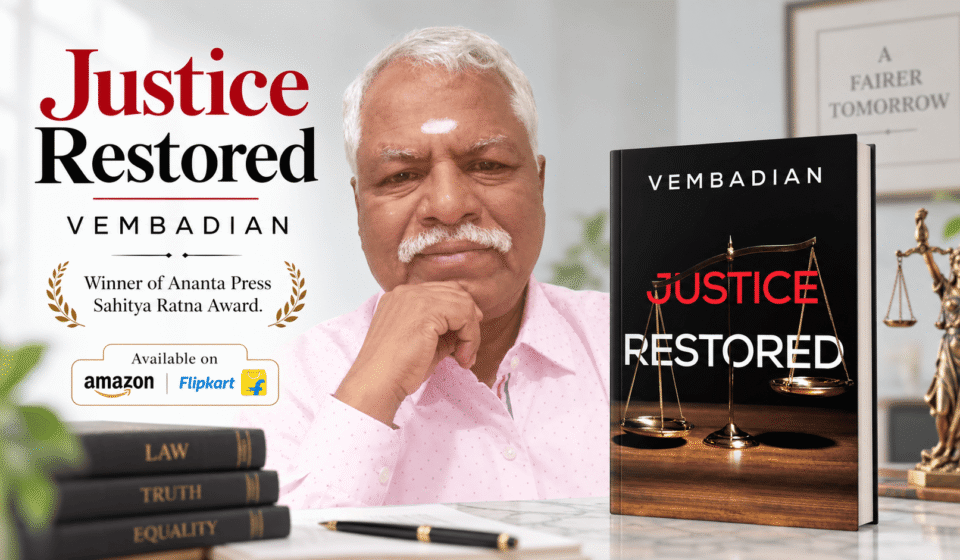

There are novels that create drama by inventing extraordinary dangers, and there are novels that find drama in the ordinary systems that quietly shape people’s lives. Vembadian’s Justice Restored belongs to the second category. Its central conflict is not a battlefield, a criminal conspiracy, or a spectacular catastrophe. It is a failure of administration: a sincere last-grade employee suffers a serious workplace injury, receives medical treatment, is transferred for psychiatric care, and then becomes trapped in a bureaucratic misunderstanding so severe that his hospitalisation is treated as unauthorised absence. What follows is a story of salary stoppage, removal from service, family hardship, and a long-delayed attempt to correct an institutional wrong. In making this the foundation of a novel, Vembadian turns paperwork, communication, responsibility, and public duty into matters of genuine human consequence.
The emotional force of Justice Restored comes from the distance between what should have happened and what actually happened. Mahesh Gupta is introduced as a sincere, honest and devoted employee. His difficulty does not arise because he deliberately abandons his duty. He is injured while working, treated in a government hospital, and later shifted to the Ranchi Mental Hospital when abnormal speech and behaviour raise medical concerns. At each stage, his condition is connected to his workplace injury and treatment. Yet the administrative system does not successfully carry this truth from one office to another. A communication gap becomes an official record; the official record becomes a disciplinary conclusion; and the disciplinary conclusion becomes suffering for an entire family. The novel’s strongest idea is contained in this chain: an error inside a file is never only an error inside a file when a human life depends on it.
This gives the book unusual social relevance. Bureaucracy is often discussed in broad terms through words such as delay, inefficiency, procedure and negligence. Vembadian gives those abstractions faces. The unpaid salary means Mahesh Gupta’s wife and son struggle to survive. The son’s education is affected. The family makes representations, but the existing interpretation of the case remains unchanged. By connecting official inaction to food, schooling, dignity and security, the novel asks readers to look beyond documents and consider the people represented by those documents. The administrative failure is therefore not presented merely as a technical mistake. It is shown as a moral failure to investigate carefully and to understand an employee’s actual circumstances.
The character of the newly appointed HRD Chief, Mohan, is important because he represents a different model of authority. He does not accept the earlier decision simply because it already exists in the record. The letter from a Lieutenant Colonel regarding Mahesh Gupta’s delayed benefits becomes a reason to reopen the question. Mohan notices that something does not add up. Why would a last-grade employee remain absent for such a prolonged period? Was the absence truly wilful? Was the case adequately examined before removal? These questions are simple, but they are exactly the kind of questions that can disappear when administration becomes mechanical. Mohan’s leadership is defined not by dramatic speeches but by attention, suspicion of an incomplete narrative, and willingness to verify facts.
The welfare investigation becomes the turning point because it uncovers the missing context: Mahesh Gupta had been shifted for psychiatric treatment, and the salary-drawing office had not received the necessary information. This is where the novel’s title begins to earn its meaning. Justice is not restored through luck alone. It is restored through a process of looking again, checking what was overlooked, and persuading those with authority to correct the official record. Mohan and Senior HR Manager Mishra function as agents of administrative conscience. They show that systems are not automatically just or unjust; their quality depends heavily on the care, integrity and judgement of the people operating them.
One of the book’s distinctive qualities is that it treats administrative reform as a human story rather than as a policy lecture. Readers see why procedure exists, but they also see why procedure must never replace thought. A rule applied without context can produce injustice. An official order based on incomplete information can appear technically defensible while remaining fundamentally unfair. Vembadian’s professional background in human resources and railway administration gives this dimension particular credibility. The story appears to understand the internal logic of service matters, disciplinary decisions, retirement benefits and compassionate appointments. That familiarity allows the plot to move through bureaucratic mechanisms without reducing them to meaningless jargon.
At the same time, Justice Restored remains accessible because its moral structure is clear. Mahesh Gupta is vulnerable precisely when the institution should be protecting him. His injury occurs while he is carrying out his work. His later mental-health condition makes communication more difficult. His family lacks the power and administrative knowledge to challenge the system effectively. The eventual correction therefore feels significant because it recognises an imbalance between the individual and the institution. The new HRD Chief uses institutional authority not to defend the institution’s past decision but to repair the harm caused by it.
The final decisions – cancellation of the removal order, retirement on medical grounds, settlement of benefits, and compassionate appointment for Mahesh Gupta’s son – carry emotional weight because they arrive after irreversible loss. Mahesh Gupta and his wife have already died by the time the case is properly investigated. This prevents the ending from becoming simplistic. Justice is restored, but not in the sense that every loss can be undone. The salary that should have protected a family cannot give back years of hardship. An appointment for the son cannot restore the parents who suffered. The book therefore leaves readers with a more mature understanding of delayed justice: correction matters profoundly, but institutions should not wait until damage becomes permanent.
Another strength is the ethical optimism of the novel. It criticises negligence, but it does not suggest that every public servant is uncaring or that every system is beyond repair. Instead, it presents reform from within. Mohan, Mishra and the general manager demonstrate different stages of responsible administration: questioning, investigating, recommending and approving corrective action. The book’s hope is practical rather than sentimental. It suggests that empathy becomes effective when joined with evidence, procedure, persistence and the courage to admit that an earlier decision was wrong.
This combination of moral seriousness and administrative realism makes Justice Restored stand out within general fiction. It is a novel about governance, but its real subject is responsibility. It asks what happens when officials forget that files represent people, and what becomes possible when one responsible person decides to look beyond the file. Readers interested in social justice, workplace ethics, government administration, compassionate leadership and stories rooted in everyday realities will find much to reflect on here.
Vembadian has described his writing as having a dual purpose: to give readers literary enjoyment and to offer useful ideas, morals and examples worth carrying into life. Justice Restored clearly reflects the second part of that purpose, while also building its narrative around suspense of a different kind – the suspense of whether an institution will recognise the truth hidden beneath its own paperwork. The result is a socially conscious novel whose message is direct but important: justice requires more than rules. It requires attention, empathy, courage and a willingness to correct what has gone wrong.
Amazon: https://www.amazon.in/Justice-Restored-Vembadian/dp/1804391484/ref=sr_1_1