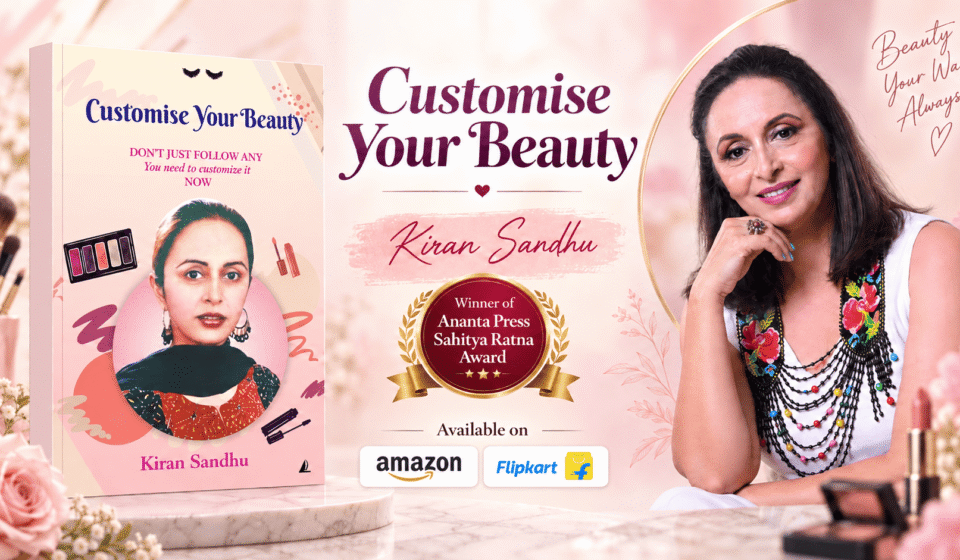

In a beauty market crowded with trends, product launches, celebrity routines, and promises of instant transformation, Customise Your Beauty by Kiran Sandhu takes a refreshingly different route. Instead of telling readers that there is one ideal routine, one universally flattering look, or one set of products that everyone should buy, the book is built around a more sensible question: what actually suits you? That question becomes the foundation of the entire guide. Sandhu’s central philosophy is that beauty becomes more meaningful and more effective when a person understands her own skin, facial structure, body shape, colouring, and individual requirements before making choices. This turns the book from a conventional beauty manual into a practical exercise in self-observation and informed decision-making.
One of the strongest qualities of the book is the way it challenges passive consumption. Beauty advice is often presented as a stream of instructions: use this cream, follow this trend, wear this shade, apply makeup this way. Customise Your Beauty repeatedly shifts responsibility back to the reader. It encourages readers to identify their skin type, recognize what their skin may need, understand the ingredients in products, and then choose accordingly. That may sound straightforward, but it is an important change in perspective. The reader is not treated as someone who simply needs more recommendations. She is treated as someone capable of understanding the logic behind a recommendation and making an intelligent choice for herself.
This emphasis on self-knowledge also makes the book more durable than trend-based beauty writing. Trends change quickly. A product that dominates social media today may disappear from attention tomorrow. But the ability to observe whether one’s skin is dry, oily, combination, sensitive, or experiencing a particular concern remains useful. Similarly, knowing one’s face shape, eye characteristics, body proportions, and colour undertone has value beyond a single season. Sandhu therefore gives readers a framework rather than merely a list. The book’s underlying sequence can be understood as: know yourself, customize your approach, choose thoughtfully, and then apply. That structure gives the advice a sense of continuity across skincare, makeup, clothing, colour, and lifestyle.
The skincare sections are particularly effective because they encourage readers to look beyond packaging and popularity. The modern cosmetics market can be intimidating, especially for someone who does not know why one ingredient is recommended for one skin type while another may be better suited to a different concern. Sandhu does not reduce beauty to expensive shopping. She encourages attention to ingredients and suitability. This is a valuable form of consumer literacy. A reader who understands why she is buying something is less likely to be persuaded purely by advertising, attractive branding, or a passing trend. In that sense, the book is not only about appearance; it is also about becoming a more deliberate consumer.
Another strength is the breadth of the book’s idea of customization. Sandhu does not stop at skincare. She extends the same principle to facial features, makeup, clothing, colour coordination, body shape, home-based remedies, and even weight-management planning. This gives the book the feeling of a broad personal-beauty handbook rather than a narrow skincare guide. The discussion of body shape, for instance, focuses on how different clothing cuts and designs interact with natural proportions. The point is not that every body must be forced toward one shape. Instead, the book encourages readers to understand proportion and choose clothing that creates the effect they personally want. This can help remove some of the confusion many people experience when an outfit looks appealing on a model or mannequin but feels completely different when worn by someone with another body type.
The treatment of facial features follows a similar logic. Sandhu presents makeup as something that works with the face rather than covering it. By understanding the shape and placement of the eyes and the overall face shape, readers can make choices that emphasize certain features, create visual balance, or soften areas they may prefer to make less prominent. This approach feels more individualized than rigid instructions about what is “correct.” It allows technique to serve the person rather than forcing the person to serve the technique.
Colour selection is another useful part of the book because it connects beauty with styling. The idea of warm and cool undertones, and of choosing clothing colours that harmonize with one’s complexion, is explained as another form of personal understanding. Readers who have ever wondered why one colour makes them look lively while another makes them appear tired will recognize the practical value of this discussion. Again, the book gives a reason behind the choice. It helps the reader see beauty as a system of relationships between skin, colour, shape, texture, and personal preference.
Sandhu’s inclusion of home remedies and beauty recipes adds a personal and accessible dimension. Her own interest in beauty began when she was very young, and her knowledge developed through years of observation, experimentation, home remedies, natural therapies, and commercial cosmetic products. That background gives the guide a lived-in quality. The book does not read as if beauty began with the latest generation of products. It acknowledges that self-care can include both modern cosmetics and simple home-based practices. Readers who prefer natural or DIY options will appreciate that the book leaves room for them.
The author’s professional identity as a naturopathy and wellness professional also influences the tone. Her approach links appearance to broader self-care rather than treating beauty as a purely decorative activity. This is especially important because beauty literature can easily become prescriptive or anxiety-producing. Here, the more constructive message is that understanding yourself allows you to make choices with greater confidence. The ideal outcome is not to become a copy of someone else, but to enhance what is already individual about you.
That philosophy is what makes Customise Your Beauty stand out. Its most valuable contribution is not a single tip or technique. It is the repeated insistence that personalization matters. The book asks readers to stop assuming that a popular product, fashionable colour, makeup style, or diet plan must be right for everyone. It replaces imitation with observation. For beginners, this can provide a clear starting point in an overwhelming beauty landscape. For experienced beauty enthusiasts, it can offer a reminder to evaluate habits rather than follow them automatically.
Kiran Sandhu has written a guide that is practical, approachable, and rooted in the belief that beauty is most useful when it respects individuality. Readers looking for a book that combines skincare awareness, makeup understanding, styling guidance, colour coordination, home care, and self-knowledge will find a great deal to explore here. More importantly, the book encourages a mindset that can remain relevant long after individual products and trends have changed: understand yourself first, and let your choices grow from that understanding.
Amazon: https://amzn.in/d/01hSkygC