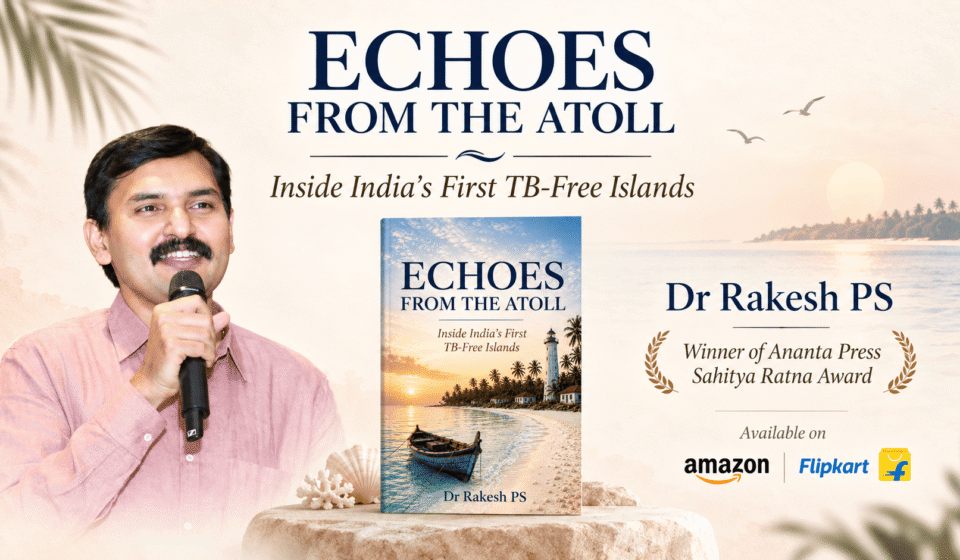

There are books that explain public health, and there are books that allow readers to feel what public health looks like when it is lived. Echoes from the Atoll: Inside India’s First TB-Free Islands belongs firmly to the second category. Dr Rakesh PS takes a subject that could easily have become a technical account of tuberculosis control and turns it into a reflective literary memoir about people, place, service, belonging and change. That transformation is the book’s greatest strength.
At the centre of the narrative is Lakshadweep, a group of islands that many readers may know only through photographs, tourism references or geography lessons. Here, however, Lakshadweep is not treated as a picturesque backdrop. It is presented as a living environment that shapes every aspect of daily life, including the way healthcare is organised and delivered. Distance is not simply measured in kilometres. It is felt through the sea, through travel between islands, through weather, through isolation and through the practical realities of reaching people. The geography of the islands becomes inseparable from the story of tuberculosis elimination.
That perspective immediately distinguishes the book from a conventional public health account. Readers are not asked to begin with epidemiological terminology, programme indicators or institutional frameworks. Instead, they begin with human encounters. Health workers, families, community leaders and island residents appear as the real carriers of the story. The achievement of moving towards TB-free certification is important, but the author does not reduce it to a success statistic. He shows that a public health milestone is meaningful because of the people who worked quietly, repeatedly and collectively to make it possible.
This human-centred approach is especially valuable because tuberculosis is often discussed in the language of burden, targets, detection, treatment adherence and elimination strategies. Such language is necessary within health systems, but it can create distance for general readers. Echoes from the Atoll closes that distance. It reminds us that behind every notification, every household visit and every treatment journey is a person living within a family and a community. The book’s emphasis on ASHAs, health workers, families and local leadership gives visibility to the many individuals whose efforts rarely become part of public narratives.
One of the book’s most compelling ideas is that elimination cannot simply be imposed as a programme. It must become a shared aspiration. The description of the TB-free journey suggests that the goal gradually moved from the domain of health administration into the consciousness of the community. That shift is profound. A disease-elimination programme becomes more durable when people do not see it as somebody else’s target, but as something connected to the well-being and identity of their own home. In the islands, the possibility of saying that tuberculosis no longer had to belong there appears to have carried emotional as well as public health significance.
Dr Rakesh writes from a position that is unusual and therefore especially interesting. He was not merely an observer travelling through Lakshadweep, nor was he only a technical professional looking at a health programme from outside. He spent years working in public health and became immersed in island life. This gives the memoir a dual perspective: that of a professional trained to notice systems and that of a person gradually transformed by the people and place around him. The movement from assignment to attachment gives the book its emotional architecture.
The memoir is also strengthened by the author’s professional background. Dr Rakesh PS is a public health physician, researcher and educator with extensive experience in community-driven healthcare, disease prevention and health systems strengthening. His work with organisations including the World Health Organization and The International Union Against Tuberculosis and Lung Disease, along with his involvement in TB elimination initiatives, gives him a deep understanding of the subject. Yet the book’s appeal lies in the fact that he does not use expertise to dominate the story. Instead, expertise seems to give him a sharper appreciation of how much health programmes depend on relationships, trust and local context.
This balance between knowledge and humility makes the book accessible to readers who have no background in medicine. The memoir does not require the reader to understand the technical architecture of a TB programme before appreciating what is at stake. A reader interested in travel, community life, development, social change or human relationships can enter the book through those doors. Public health emerges naturally from the narrative rather than standing in front of it as a barrier.
Another important layer is the tension between tradition and modernity. Lakshadweep is presented as a place in transition, and the book appears attentive to the emotional complexity of that change. Modernisation is rarely a simple story of progress replacing the past. Communities may welcome new opportunities while also worrying about the erosion of practices, relationships or cultural rhythms that have long defined them. By placing this tension beside the TB-free journey, the memoir becomes much larger than a health story. It becomes an account of how a community negotiates change on several fronts at once.
This is where the title Echoes from the Atoll becomes especially appropriate. An echo is not the original sound; it is what remains, returns and changes as it travels through a space. The idea suits a memoir concerned with memory, transformation and belonging. The author’s experiences in the islands seem to continue speaking after the professional assignment itself. The people and places become more than memories of work. They become questions about what it means to belong somewhere and what remains with us after we leave.
The book also raises an important question for anyone working in development, governance or public service: how do we understand the communities we are trying to serve? Technical solutions are often designed through plans, targets and administrative structures. But communities are shaped by histories, geographies, relationships and identities that cannot be captured fully in a spreadsheet. Lakshadweep’s sea routes, distances and island-specific realities demanded a health response suited to the place. The memoir therefore offers a larger lesson: good public systems must listen to geography and culture as carefully as they listen to policy.
The global release of the book by Dr Lucica Ditiu, Executive Director of the Stop TB Partnership, in the presence of global health leaders, adds another dimension to its significance. Yet the book’s real achievement is not institutional recognition. It is the decision to preserve a public health success story in human terms. Many important achievements disappear into reports once targets are met. By turning this experience into literary nonfiction, Dr Rakesh gives the story a longer life and a wider audience.
For health professionals, Echoes from the Atoll can serve as a reminder that empathy is not separate from effective public health; it is central to it. For readers outside healthcare, it provides an accessible window into how community health work unfolds in places where geography itself demands creativity. For those interested in Lakshadweep, it offers something deeper than scenery: a portrait of people negotiating continuity, aspiration and change.
What makes the book unique is therefore not any single subject. It is the way several subjects are woven together. Tuberculosis is present, but the book is not only about disease. Lakshadweep is central, but the book is not simply travel writing. The author reflects on his own experience, but the memoir does not become self-absorbed. The islands’ transformation matters, but the narrative does not reduce change to a debate between old and new. Instead, the book allows these themes to coexist.
Echoes from the Atoll is ultimately a story about the invisible work through which communities become healthier. It honours the health workers who knock on doors, the families who participate, the leaders who help build trust and the professionals who learn that listening is as important as planning. It also honours the emotional complexity of a place that can become home even to someone who arrived there for work.
The book’s final impression is one of connection. Science connects with storytelling. Professional duty connects with personal transformation. A national public health goal connects with local aspiration. Islands separated by water connect through a shared vision. And readers, even those who have never visited Lakshadweep or worked in public health, are invited to connect with a universal truth: large achievements are ultimately built from human relationships.
For anyone looking for nonfiction that combines social observation, public health, travel, reflection and a genuine respect for community, Echoes from the Atoll offers a distinctive and meaningful reading experience. It makes an important public health achievement understandable not because it simplifies the work, but because it restores the people to the centre of the story.
Amazon Link: https://www.amazon.in/Echoes-Atoll-Inside-TB-Free-Islands/dp/9375002454